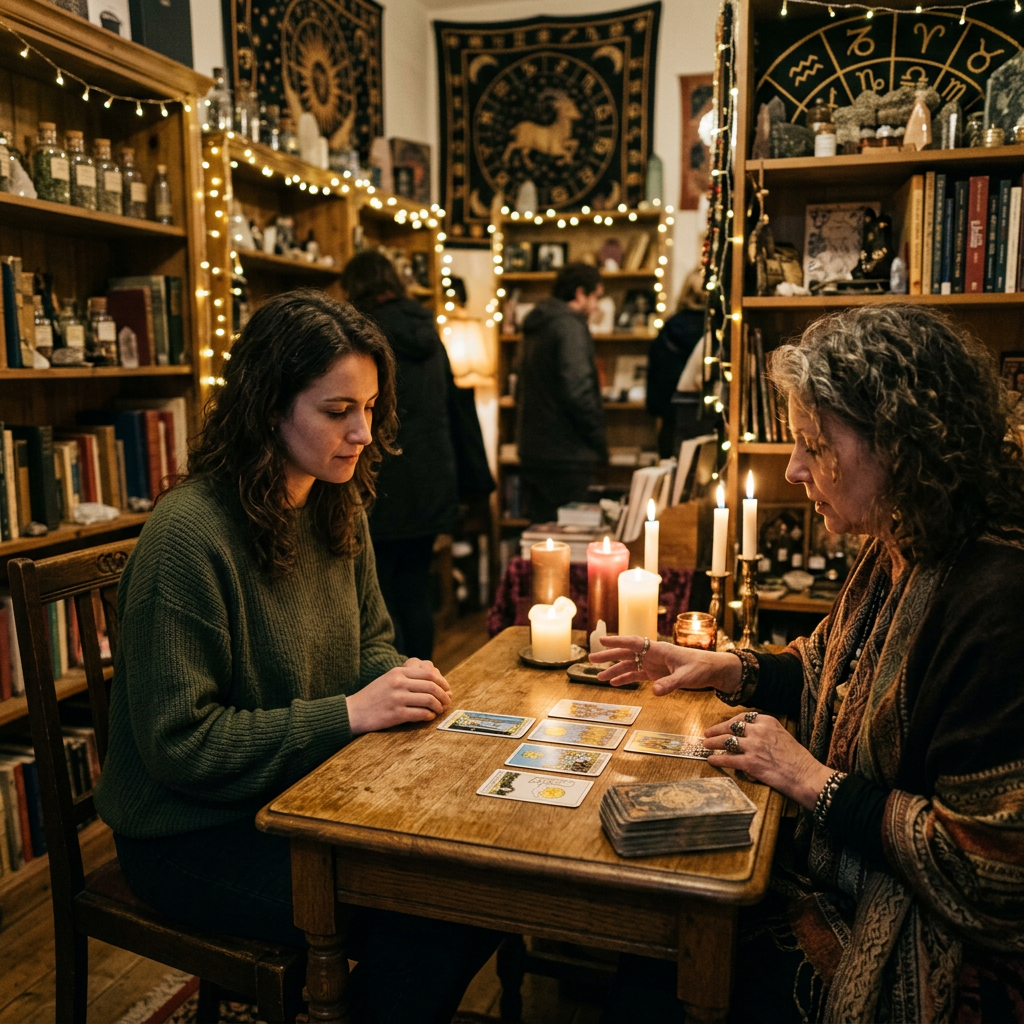
Walking into a tarot shop or booking a psychic reading is not automatically a scam, but the risk of exploitation is higher because these services often operate at the intersection of vulnerability, money, and unequal authority. People typically seek readings during grief, uncertainty, infertility, relationship distress, or major life transitions—states that can lower skepticism and increase susceptibility to fear-based messaging, pressure to purchase repeated sessions, or claims that only the practitioner possesses the truth.
In a personal essay, Julie Gordon describes how what began as occasional, mostly lighthearted psychic and tarot readings escalated into an eight-year addiction following a midlife crisis and a painful romantic rejection that left her isolated on Salt Spring Island (Gordon, 2025). She explains how pay-per-minute online platforms—featuring thousands of advisors, instant access, persuasive reviews, and frictionless payment systems—fed a compulsive cycle of anxiety and short-lived relief that ultimately drained her savings, maxed out her credit, and cost her nearly half a million dollars when lost income and interest are included (Gordon, 2025). Gordon links her dependency to behavioral addiction dynamics similar to gambling, particularly the way grief, loneliness, and uncertainty drive “psychic junkies” to chase reassurance and imagined futures, while criticizing an industry that profits from vulnerable users with minimal safeguards beyond “entertainment only” disclaimers (Gordon, 2025). After hitting rock bottom with looming tax debt and financial collapse, she begins rebuilding through steady work, community, and family support, reframing psychics as occasional, limited guidance rather than sources of certainty—still acknowledging that some practitioners may have genuine gifts, but rejecting the idea that anyone can reliably predict the future (Gordon, 2025).
Historical patterns reveal that the tension between spiritual care and exploitation is not new. Ring and colleagues analyze Scotland’s witchcraft era (1563–1736) through a nursing and midwifery lens, identifying 142 individuals—mostly women—accused due to their roles in folk healing and midwifery (Ring et al., 2024). They find that more than half were convicted and, among those with known outcomes, most were executed, with accusations frequently framing care as maleficium or as spiritually “unorthodox,” particularly in post-Reformation contexts where Catholic-associated practices became suspect (Ring et al., 2024). The authors document that many accused practitioners used recognizable care practices—ritualized actions, prayers, and holistic treatments involving herbs, foods, baths, and poultices—some of which align with later nursing and midwifery knowledge and possess known therapeutic properties (Ring et al., 2024). A smaller subgroup, especially in the late sixteenth and early seventeenth centuries, employed complex and sometimes costly remedies resembling elite medical knowledge rather than folk tradition, suggesting links to pre-Reformation monastic healthcare and illustrating how gender, religion, and the professionalization of medicine contributed to the marginalization of women’s healing work (Ring et al., 2024).
Contemporary examples show how similar dynamics persist under modern market conditions. Antonia Hoyle (2024) describes how infertility makes people especially vulnerable to exploitation by unregulated “fertility experts” and spiritual advisors who offer certainty where medicine cannot, often through expensive and unproven services such as fertility-focused acupuncture, psychics, tarot readers, and astrologers. Through women’s accounts—such as Lynsey being promised pregnancy by an acupuncturist despite unclear evidence, Amanda spiraling into anxiety after conflicting psychic “gender” predictions, and Catriona being emotionally harmed by astrologer-blame narratives—the article demonstrates how false reassurance, manipulation, and misinformation can intensify grief, guilt, and distress following miscarriages or failed treatments (Hoyle, 2024). The piece also highlights how a booming fertility market, low IVF success rates among older women, and social-media algorithms that target struggling individuals with fertility “solutions” create ideal conditions for unethical claims and profiteering, even as legitimate clinicians emphasize that complementary therapies may reduce stress but are unlikely to cause pregnancy on their own (Hoyle, 2024).
When low-income clients or stressed workers spend hard-earned savings on repeated spiritual services, the harm becomes structural rather than merely individual, echoing other systems in which dependence, urgency, and emotional leverage are used to extract resources without meaningful accountability. For this reason, the ethical question is less about whether spirituality is “real” and more about whether autonomy is protected—through informed consent, transparent pricing, clear boundaries, and the absence of coercion or guilt. This autonomy-centered ethic appears consistently across helping professions. Counselors are cautioned against drifting into theological advocacy or becoming de facto religious representatives and are instead urged to engage clients’ religious and spiritual concerns in ways grounded in psychological science and client well-being (Piedmont, 2024). Similarly, philosophical counseling frameworks emphasize spiritual competence, self-awareness, and strict non-imposition of the counselor’s beliefs, ensuring that spirituality supports clients’ values rather than reinforcing professional authority (Ganjvar, 2025).
Even in palliative care, ethical spiritual support is framed as deep listening and patient-centered, non-directive communication—honoring individuals’ meaning-making without steering, fixing, or inserting the clinician’s worldview (Taylor, 2021). Law has historically grappled with these same boundaries between belief and exploitation. Canada’s former witchcraft provision, for example, evolved from policing “bad religion” to targeting “bad business,” particularly fraudulent fortune-telling, illustrating how public concern often shifts from spiritual deviance to economic harm and abuses of power (Bad Religion and Bad Business, 2024). At the same time, research on spiritualist labor shows that many tarot readers do aim to help clients and develop personal ethical codes, yet their precarious, stigmatized work and lack of formal oversight heighten boundary risks—especially when practitioners function in quasi-therapeutic roles for vulnerable individuals (Lavin, 2021). Cross-culturally, fortune-telling can also operate as relational care and moral guidance under conditions of stigma and economic precarity, complicating simple “scam versus legitimate” labels while reinforcing the need to focus ethically on reciprocity, responsibility, and power (Jiang, 2025). Ultimately, the core issue is whether spiritual services—or workplaces, clinics, and counseling spaces—protect consent, transparency, and self-determination, or whether they leverage fear and dependency to extract money, loyalty, or compliance.
References
Bad Religion and Bad Business: The History of the Canadian Witchcraft Provision. (2024). Canadian Journal of Law & Society / Revue Canadienne Droit et Société, 39(1), 1–20. https://doi.org/10.1017/cls.2024.8
Ganjvar, M. (2025). From concept to practice: Integrating ethical spirituality into philosophical counseling training. Journal of Medical Ethics & History of Medicine, 18(7), 1–18. https://doi.org/10.18502/jmehm.v18i7.19421
Gordon, J. (2025). My Secret Addiction. Maclean’s, 138(11), 52–58.
Hoyle, A. (2024). Struggling with infertility: Why so many women are going to psychics and tarot readers to fulfil their baby dreams. Daily Mail, 32.
Jiang, Z. (2025). “Becoming free” through fortune-telling: Value-seeking, spiritual cultivation and personhood among rural aunties in urban China. Journal of Chinese Sociology, 12(1), 1–16. https://doi.org/10.1186/s40711-025-00241-3
Lavin, M. F. (2021). On spiritualist workers: Healing and divining through tarot and the metaphysical. Journal of Contemporary Ethnography, 50(3), 317–340. https://doi.org/10.1177/0891241620964951
Piedmont, R. L. (2024). Some comments on the ethical use of religious and spiritual constructs in clinical practice. Counseling & Values, 69(3), 347–361. https://doi.org/10.1163/2161007x-bja10028
Ring, N. A., McHugh, N. M., Reed, B. B., Davidson-Welch, R., & Dodd, L. S. (2024). Healers and midwives accused of witchcraft (1563–1736): What secondary analysis of the Scottish Survey of Witchcraft can contribute to the teaching of nursing and midwifery history. Nurse Education Today, 133. https://doi.org/10.1016/j.nedt.2023.106026
Taylor, E. J. (2021). Communicating with persons who express spiritual struggle at the end of life. Journal of Hospice & Palliative Care, 24(4), 199–203. https://doi.org/10.14475/jhpc.2021.24.4.199