Research on makeup consistently reveals a tension between agency and social judgment—between what women feel makeup does for them and how others respond to it. Experimental work suggests that makeup may not substantially alter how women see themselves, but it does shape how others perceive their competence, morality, and sexuality in subtle, stereotype-driven ways (Kellie et al., 2021). In one set of studies, women’s self-perceptions of agency, humanness, and confidence remained largely unchanged regardless of makeup use. Yet observers attributed different mental and moral qualities to women depending on perceived attractiveness and assumptions about sexual behavior, underscoring how makeup operates less as a tool of self-transformation and more as a social signal filtered through bias (Kellie et al., 2021).
Qualitative research complicates this picture further. Women’s lived relationships with makeup are often ambivalent rather than purely empowering or oppressive. Some women experience makeup as a confidence-boosting ritual or a creative extension of the self, while simultaneously feeling uneasy about how dramatically it can alter appearance or how praise disappears when it comes off (Spezzacatena & Marsico, 2021). Regular users tend to develop a steadier, more integrated relationship with makeup, whereas occasional users often find themselves negotiating its benefits and costs—authenticity versus polish, comfort versus social approval—on a daily basis (Spezzacatena & Marsico, 2021). This ambivalence reflects makeup’s role as a “micro-mask”: temporary, reversible, and emotionally loaded.
Cultural and structural contexts further shape how makeup is interpreted. In South Korea, shifting gender norms and increased gender equality have contributed to greater acceptance of men’s makeup, particularly among women who support non-traditional gender roles (Han & Choi, 2023). These findings suggest that makeup norms are not fixed; they move alongside broader changes in power, labor, and identity. At the same time, legal scholarship shows how appearance is tightly regulated in professional settings, where grooming and dress codes often encroach on autonomy, privacy, and self-expression—especially for workers with less power to resist (Delagrave, 2025). Whether makeup is framed as “professionalism” or “choice,” the burden of compliance disproportionately falls on women and other marginalized workers.
Feminist scholarship from China names this pressure directly as beauty servitude: a form of social discipline sustained not only by institutions and media, but by internalized self-surveillance (Li & Li, 2025). Women may intellectually reject beauty norms while still feeling emotionally tethered to them. Resistance, then, is rarely absolute. It shows up instead in everyday decisions—wearing less makeup, skipping it in certain spaces, or selectively conforming when the stakes feel too high. These small acts of resistance do not always dismantle the system, but they can loosen its grip and restore moments of psychological relief (Li & Li, 2025).
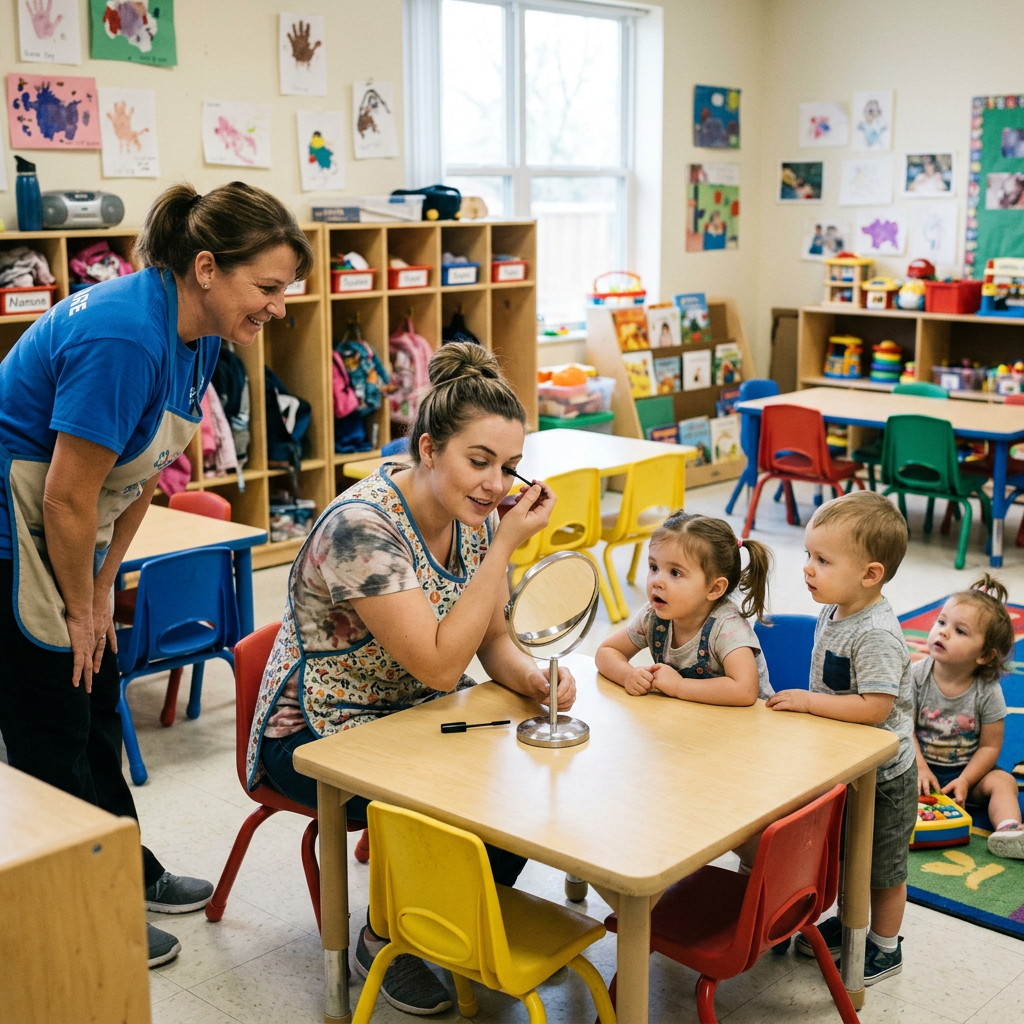
My own relationship with makeup lives squarely in this in-between space. I like wearing makeup. Yet there were years when I worked with children and felt there was no real purpose to it in that environment. Over time, though, I noticed something uncomfortable: I was treated better when I looked “presentable” and awake. Without makeup, I was read as dull, tired, less competent—and I internalized that judgment. Wearing makeup wasn’t about pleasing others; it became part of my routine, my ritual. Getting ready gave me something to look forward to. It helped me pull my outfits—and myself—together. When I felt confident inside, it showed outwardly.
I’ve also learned that people treat me differently depending on whether I “look the part.” When I don’t wear makeup, I am more likely to be dismissed, disrespected, or underestimated. When I do, people listen, admire, and extend respect. I don’t need that validation—but I’m not immune to the world I live in. Makeup, for me, has sometimes functioned as a coping mechanism: a way to move through chaos with a little more ease, a small pocket of peace in a system that constantly evaluates women’s worth through appearance.
What these studies—and my own experience—make clear is that makeup is never just makeup. It sits at the intersection of identity, power, labor, and survival. Whether it feels like armor, ritual, resistance, or burden depends not only on personal choice, but on the social structures surrounding that choice. Understanding makeup through this lens allows us to move beyond simplistic narratives of empowerment versus oppression and instead ask harder questions: Who gets to opt out? At what cost? And what would it look like to be respected either way?
References
Delagrave, A.-M. (2025). Workplace Appearance Regulation in Canada as an Invasion of Privacy and a Violation of Freedom of Expression. Canadian Labour & Employment Law Journal, 26(2), 479–525.
Han, J. S., & Choi, J. H. (2023). Women’s non-traditional gender role attitudes and acceptance of men’s color makeup in South Korea. Journal of Gender Studies, 32(6), 575–587. https://doi.org/10.1080/09589236.2022.2032624
Kellie, D. J., Blake, K. R., & Brooks, R. C. (2021). Behind the makeup: The effects of cosmetics on women’s self‐objectification, and their objectification by others. European Journal of Social Psychology, 51, 703–721. https://doi.org/10.1002/ejsp.2767
Li, M., & Li, Y. V. (2025). The Rejection of Beauty Servitude: Voices from Chinese Feminists. Women’s Studies, 54(4), 431–454. https://doi.org/10.1080/00497878.2025.2477263
Mitchell, R. L., Awasty, N., Hahn, R. S., Griffin, D. J., & Hollenbeck, J. R. (2025). I’m Not Feeling It: The Role of Affective Diversity in Risk Management and Team Performance. Human Resource Management, 64(2), 375–393. https://doi.org/10.1002/hrm.22265
Spezzacatena, M., & Marsico, G. (2021). How Does Ambivalence Appear in Women’s Relationship to Cosmetics? Integrative Psychological & Behavioral Science, 55(1), 128–166. https://doi.org/10.1007/s12124-020-09572-x