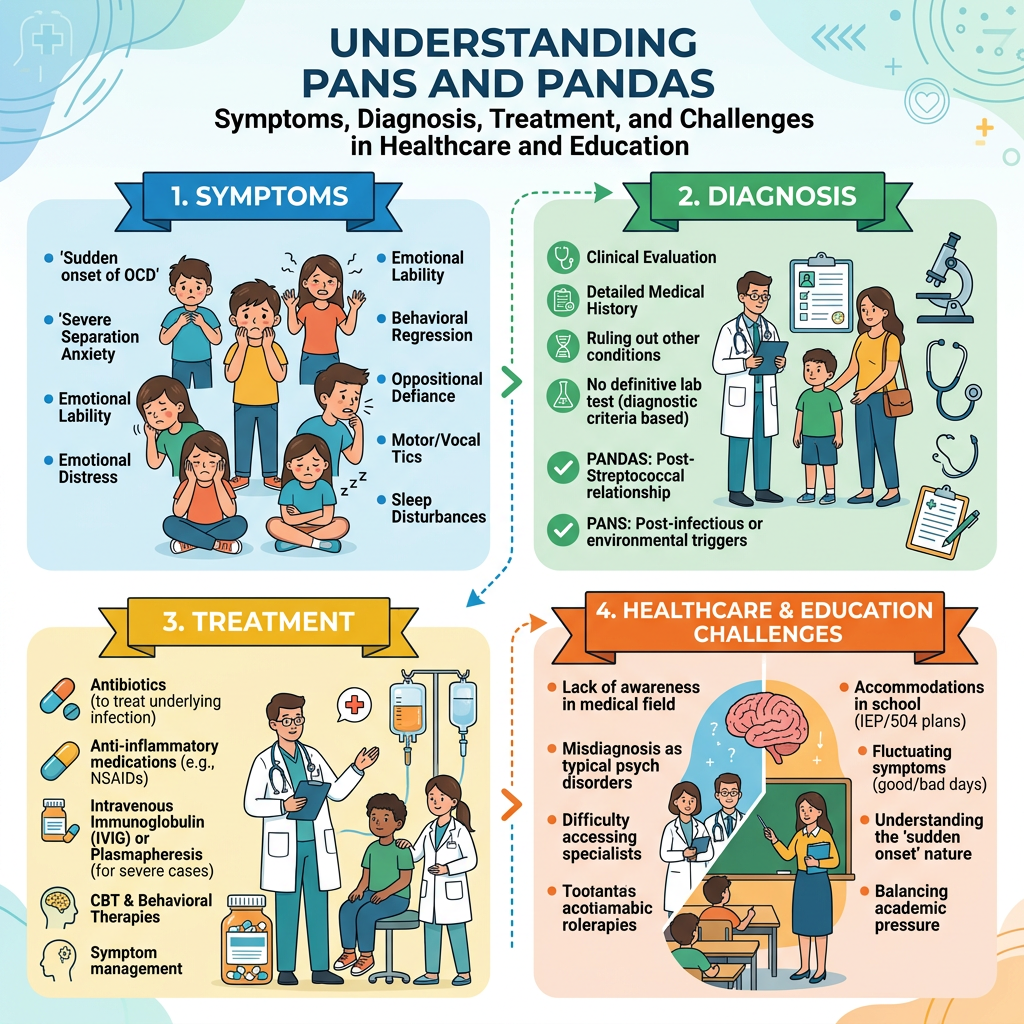
Pediatric Acute-Onset Neuropsychiatric Syndrome (PANS) and Pediatric Autoimmune Neuropsychiatric Disorders Associated with Streptococcal Infections (PANDAS) are complex childhood conditions characterized by the sudden onset of behavioral, emotional, and neurological symptoms. Although these conditions share many similarities, they differ in their suspected underlying causes. According to Kellner (2026), PANDAS is associated with Group A streptococcal infections, commonly known as strep throat, while PANS involves similar neuropsychiatric symptoms that are not necessarily linked to streptococcal infections. Children affected by these conditions may suddenly experience obsessive-compulsive disorder (OCD), tics, anxiety, irritability, aggression, emotional regression, sleep disturbances, restrictive eating, and declining academic performance. These unexpected behavioral changes can significantly interfere with children’s daily functioning, emotional well-being, social relationships, and educational development (Kellner, 2026). Understanding the symptoms, possible causes, and challenges associated with PANS and PANDAS is essential for promoting early recognition and ensuring that affected children receive appropriate medical and educational support.
One proposed explanation for PANDAS involves an abnormal immune response following a streptococcal infection. Matula (2021) explains that when a child develops a Group A streptococcal infection, the immune system may mistakenly target certain areas of the brain, particularly the basal ganglia, which are responsible for regulating movement, cognition, speech, and emotions. This proposed autoimmune response may contribute to inflammation and the sudden appearance of neurological and psychiatric symptoms. According to Matula (2021), children with PANDAS may experience OCD, involuntary movements or tics, anxiety, depression, irritability, hallucinations, developmental regression, and difficulties with academic performance. However, the exact biological mechanisms underlying PANDAS remain uncertain. Kennair (2014) discusses the proposed connection between streptococcal infections and childhood OCD symptoms but emphasizes that PANDAS remained a controversial diagnosis at the time of publication because of limitations in the available scientific evidence. While Matula (2021) highlights the potential neurological effects of an abnormal immune response, Kennair (2014) encourages further scientific investigation to better understand whether PANDAS represents a distinct medical condition or a variation of existing neuropsychiatric disorders. Together, these perspectives demonstrate the importance of examining both biological explanations and scientific uncertainty when studying PANS and PANDAS.
One of the greatest challenges associated with PANS and PANDAS is obtaining an accurate and timely diagnosis. Because these conditions can resemble other behavioral, psychological, and neurological disorders, healthcare professionals must carefully evaluate a child’s symptoms, medical history, and possible exposure to infections. Kellner (2026) explains that there are no definitive biomarkers for diagnosing PANS and PANDAS, making it necessary for pediatricians to rule out other possible medical or psychological explanations. Similarly, Matula (2021) emphasizes that diagnosis requires consideration of clinical symptoms, laboratory findings, and the possible relationship between the onset of symptoms and previous streptococcal infections. The sudden appearance of symptoms is particularly important because children may demonstrate typical behavior and development before experiencing significant emotional and behavioral changes. Matula (2021) also stresses the potential consequences of delayed diagnosis, explaining that untreated or unrecognized symptoms may contribute to recurring behavioral difficulties, emotional distress, and disruptions in cognitive and developmental functioning. Drawing from her personal experience, Matula shares that her younger sister remained undiagnosed for nearly ten years and subsequently experienced cognitive impairment and decline. Her family’s experience highlights the importance of increasing awareness among parents, pediatricians, and other healthcare professionals so that children experiencing sudden behavioral changes can receive appropriate evaluations and timely interventions.
Beyond the medical challenges, families of children with PANS and PANDAS often experience significant emotional, financial, and social difficulties while seeking appropriate healthcare. LaRusso and Abadía-Barrero (2021) examine how medical uncertainty, limited professional awareness, and disagreements among healthcare providers regarding the legitimacy of these diagnoses can create barriers to treatment. Through interviews with affected families, the researchers found that many parents felt dismissed or misunderstood by medical professionals, leading them to seek specialized care and alternative treatment options that were frequently not covered by health insurance. These experiences often resulted in financial hardship, employment difficulties, emotional exhaustion, and disruptions in family relationships. Furthermore, LaRusso and Abadía-Barrero (2021) argue that the traditional healthcare system often separates physical and mental health into different medical specialties, making it difficult to address conditions that involve overlapping neurological, psychological, and immunological concerns. Their findings demonstrate that families may struggle not only with managing their children’s symptoms but also with navigating a healthcare system that lacks consistent approaches to diagnosis and treatment. As a result, the authors emphasize the importance of compassionate communication, interdisciplinary collaboration, affordable healthcare, and stronger support systems that recognize the needs of both children and their families (LaRusso & Abadía-Barrero, 2021).
The effects of PANS and PANDAS also extend into educational settings, where sudden behavioral changes can interfere with children’s learning, classroom participation, and social development. Doran (2015) explains that educators are often among the first professionals to recognize unusual changes in a child’s behavior because they regularly observe students’ academic performance, emotional regulation, and interactions with peers. Children experiencing symptoms of PANS or PANDAS may suddenly demonstrate difficulty concentrating, increased anxiety, obsessive-compulsive behaviors, irritability, aggression, or declining academic performance. Without an understanding of these conditions, teachers may mistakenly interpret these behaviors as intentional misconduct, defiance, or traditional behavioral problems, potentially resulting in inappropriate disciplinary actions or ineffective classroom interventions (Doran, 2015). To address these challenges, Doran (2015) emphasizes the importance of collaboration among educators, parents, pediatricians, school psychologists, and special education professionals. Recommended educational supports include individualized education programs (IEPs), Section 504 plans, flexible academic expectations, extended time for assignments, sensory accommodations, stress-reduction strategies, and positive behavioral interventions. Because symptoms may fluctuate or worsen following infections or stressful experiences, educators must remain flexible and responsive to children’s changing needs. These strategies can help create a supportive learning environment that promotes academic success while addressing the emotional and behavioral challenges associated with PANS and PANDAS (Doran, 2015).
Effective treatment and intervention require a comprehensive approach that considers both the medical and psychological needs of affected children. According to Kellner (2026), treatment options may include cognitive behavioral therapy (CBT), selective serotonin reuptake inhibitors (SSRIs), or a combination of both, depending on the child’s symptoms and individual needs. Antibiotics are recommended when a child has a confirmed streptococcal infection, while additional supportive measures may include improving sleep habits, addressing nutritional concerns, and involving mental health professionals in ongoing care. Similarly, Kennair (2014) emphasizes the importance of evidence-based psychological treatments, particularly exposure and response prevention (ERP), for managing obsessive-compulsive symptoms. However, Kennair also raises concerns about prescribing antibiotics unnecessarily when PANDAS is suspected without sufficient evidence of an infection. His discussion highlights the importance of distinguishing between proposed biological explanations and treatments supported by clinical research. Furthermore, Kennair (2014) argues that psychological symptoms should not automatically be viewed as permanent personality traits or fixed evolutionary adaptations because many mental health conditions can improve through appropriate therapeutic interventions. These perspectives suggest that treatment should be individualized, carefully monitored, and guided by scientific evidence rather than assumptions about the underlying causes of a child’s symptoms.
Although researchers and healthcare professionals continue to examine the causes, diagnostic criteria, and most effective treatments for PANS and PANDAS, the available literature consistently emphasizes the importance of recognizing sudden behavioral changes and providing appropriate support. Matula (2021) highlights the potential benefits of early identification and intervention, while Kellner (2026) emphasizes the role of pediatricians in coordinating medical treatment and ongoing care. From an educational perspective, Doran (2015) demonstrates how teachers can contribute to early recognition and provide individualized classroom accommodations that support children’s academic, social, and emotional development. Meanwhile, LaRusso and Abadía-Barrero (2021) illustrate the challenges families experience when navigating medical uncertainty and fragmented healthcare systems. Kennair (2014) offers a more critical perspective by emphasizing the need for additional scientific evidence, careful diagnostic practices, and treatments supported by clinical research. Together, these sources demonstrate that understanding PANS and PANDAS requires consideration of biological, psychological, educational, and social factors. Ultimately, improving awareness, strengthening communication between families and professionals, encouraging interdisciplinary collaboration, and expanding evidence-based research are essential steps toward improving the quality of care and overall well-being of children affected by these conditions.
Reference
Doran, P. R. (2015). Sudden Behavioral Changes in the Classroom: What Educators Need to Know About PANDAS and PANS. Beyond Behavior, 24(1), 31–37. http://www.jstor.org/stable/26341247
Kellner, S. (2026, February). Demystifying PANS and PANDAS for pediatricians. Infectious Disease News, 39(2), 16. https://link.gale.com/apps/doc/A877825085/EAIM?u=dclib_main&sid=bookmark-EAIM&xid=014db782
Kennair, L. E. O. (2014). Evolutionary Psychopathology and Life History: A Clinician’s Perspective. Psychological Inquiry, 25(3/4), 346–351. http://www.jstor.org/stable/43866276
LaRusso, M., & Abadía-Barrero, C. (2021). ‘These doctors don’t believe in PANS’: Confronting uncertainty and a collapsing model of medical care. In L. Montesi & M. Calestani (Eds.), Managing Chronicity in Unequal States: Ethnographic perspectives on caring (pp. 197–216). UCL Press. http://www.jstor.org/stable/j.ctv1nnwhmv.15
Matula, Mary (Author), & Ficke, Marion (Mentor). (2021, April 15). The Importance of Early Diagnosis of Pediatric Autoimmune Neuropsychiatric Disease Associated with Streptococcus (PANDAS) [Video] [Video Recordings]. In Presentations from 2021 University Research Day. The Catholic University of America. University Research Day. Catholic University of America. https://jstor.org/stable/community.39177625
Leave a Reply